



Top tip for baby DJs: you’re wasting your time on beat-matching.
Aiming for silky smooth blends? Basic. Steadily rising BPMs? Clapped, mate. As our guest this week argues, why be seamless when you can go KLANGGG?
OK, the on-purpose train-wreck is not for everyone – you gotta play by the rules before you can break them, after all. But this week’s guest is living proof that doing things wrong, backwards, upside-down or simply not at all can reap creative dividends.
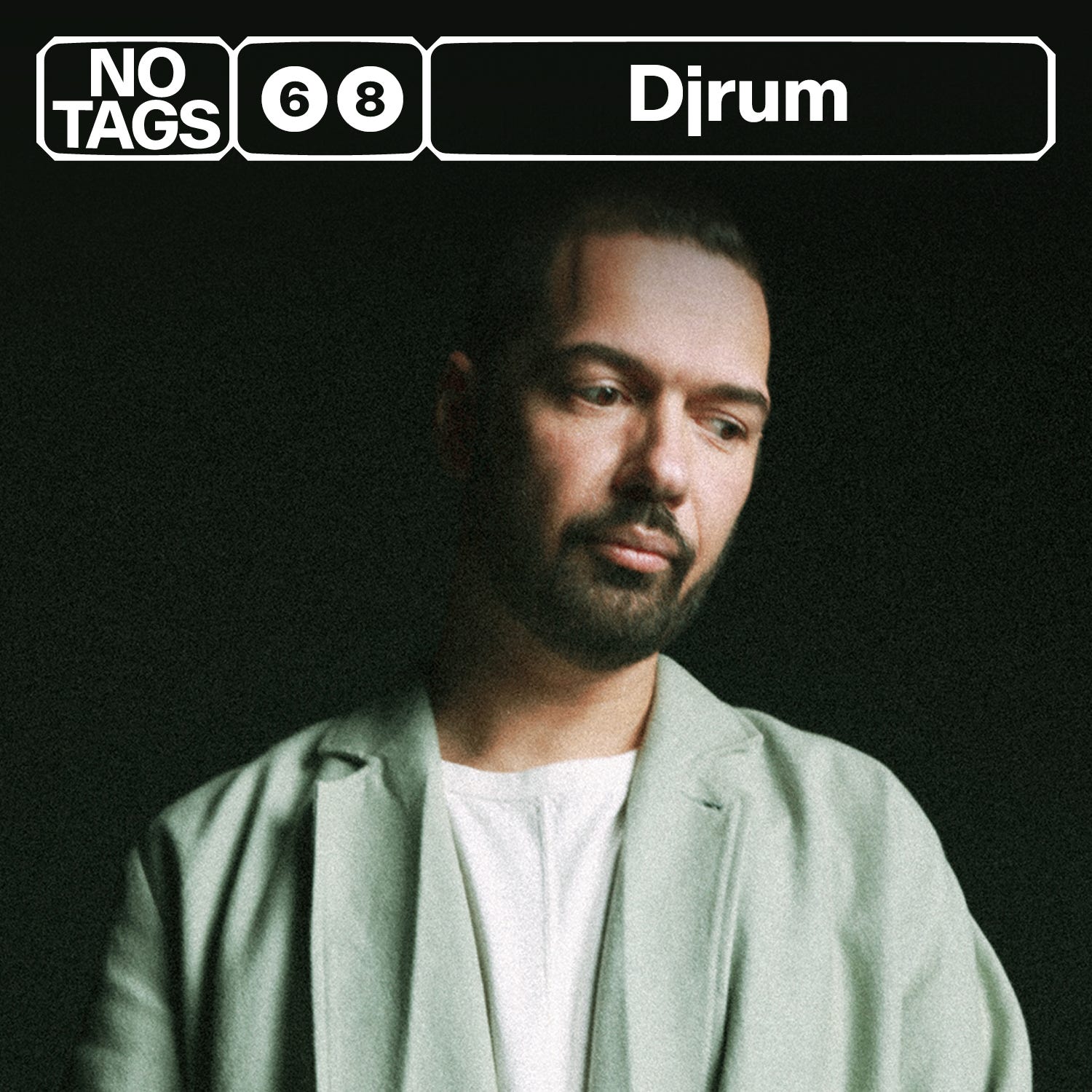
We speak, of course, about Djrum. Recorded at our book launch at London’s ICA last December, our conversation with the Oxford-dwelling DJ-producer followed up on the wild acclaim for his 2025 maybe-opus on Houndstooth, Under Tangled Silence.
In the ICA Cinema we unpacked the turbulent creative process behind the album and dug deep into his background at squat parties and early Bang Face, the pursuit of freedom which drives all his late-night endeavours, and his virtuoso approach to DJing – which is more and more about embracing chaos, and yes, clanging. (We ran out of time and didn’t ask him to pick a film – we’ll simply have to get him back.)
The interview starts at 48:00, but before that we debrief on some new music from old favourites: Boards of Canada are back. Rustie is back. Untold… is back! Is the spirit of 2011 still haunting dance music? We couldn’t possibly say.
Housekeeping. Many thanks to everyone who attended our second Listening Room session at 180 Studios with Al Wootton and Valentina Magaletti – and thanks to them for bringing some incredible records. The video will be up on YouTube in the coming weeks, and we’ll be announcing our third Listening Room session shortly. These are limited to 70 capacity and sell out very quickly, so we’ll try and get the news out to Taganistas as quickly as we can.
Next week Chal will be hosting a live interview with Mica Levi and director Jonathan Glazer to mark Under the Skin’s #1 placement on Crack’s 50 Best Film Scores of the 21st Century So Far (great list BTW). Tickets are available to Crack Supporters, so now’s a great time to subscribe.
Finally, a reminder that our second book, No Tags: Conversations on underground music culture Vol. 2 is out now. We’ve been sent photos of it in book-stores in Taipei, Mexico City and more lately which has blown our brains a bit – but if you can’t find it near you, you can buy it direct from us.
TL: You first came up throwing squat parties about 20 years ago, right?
Djrum: I was involved with a couple of different collectives of friends that were putting on squat parties in the 2000s. That era of the London squat party scene was a bunch of small sound systems and crews, with a lot of linkups between different sound systems that put on parties together. There was a lot of hard techno, gabber, wonky techno, some breakcore if you were lucky, as well as a lot of drum & bass and jungle.
At that time I just really didn’t get on with clubbing. I’d always found clubbing intimidating, I’d always found clubs intimidating. I always felt like clubs were places with lots of rules or social etiquette. Don’t draw too much attention to yourself. Don’t be too weird. The squat party scene was a place where you could be really weird and chat shit and dance like a lunatic and not really be judged. I’ve struggled to find that in clubs.
TL: My very first clubbing experiences were going underage to Fabric and I always found it quite an intimidating experience. Then I went to some smaller clubs, but just as crucially started going to warehouse parties, like House Party during the early dubstep era. Those were a huge eye-opener for me in terms of what a party can be. There must be so many people who are interested in electronic music – maybe they discover it online, via radio, whatever – but when they first go clubbing they encounter those social etiquettes you’re talking about, decide it isn’t for them and never dive any deeper into it, which is quite sad.
D: 100%, I think that’s true. Around that time there were a lot of squats in Hackney Wick which are now legitimate clubs. They were all empty warehouses. The Lord Napier pub was a squat for years, and we went to some filthy parties there. It’s a swanky, done-up pub now, but it was absolutely grotty. It was the worst pub, in the best possible way.
CR: At what point did you start DJing? Were you DJing vinyl?
D: I’ve only ever played vinyl because that’s how I started. I just haven’t caught up, I honestly don’t even know how to work the digital ones.
CR: Did you ever put yourself in the position of being the person in the squat collective who had to deal with authorities? You’re making a scared face.
D: Not me, no.
CR: That’s an inevitable part of it, isn’t it? Some parties do get shut down.
D: There were certain people in that world who were there to make mischief. I was there to make music. Mischief and just being against the system, wanting to squat as a political act – that’s essential, there are a lot of people important to the scene who weren’t really into the music as such, it was a political thing. There’s lots of other reasons for wanting to be a part of that, but I wasn’t that person.
TL: I want to talk about Bang Face. I first stumbled upon a Bang Face night at Electrowerkz really young – I didn’t know what was going on, but we wandered in from a pub, I think Mike Paradinas was playing. At 18 or 19, that’s a pretty intense night to walk into. But those parties were really formative for you, right?
D: I was a regular at those. Again, it was an opportunity to be an absolute lunatic and to lose your shit at a club night. It’s rare to find a club night that you can absolutely lose your shit in like you can at Bang Face. It feels more like a squat, actually. The venue is not nice, it’s not cleaned up, but the thing is with it not being nice, you don’t have to put on airs and graces. To me, a welcoming party is people rolling on the floor, screaming and shouting and going absolutely bonkers. That’s welcoming. People standing at the bar looking cool, that’s intimidating to me. I want to see people not just having a care in the world, dancing like no one’s looking. I know some people find that level of wildness intimidating, but to me it’s completely the opposite way around. I feel free.
TL: Are there any current parties where you’ve found that feeling?
D: I think it probably does have to be in a non-commercial venue. I was at Nowadays in New York this weekend and it felt very free, especially compared to a lot of the club scene in the United States, but there are still people posing and dressing up. I think to feel completely free and open it needs to be a non-commercial venue for me, but I don’t get to play those places so often now. I have to earn some money.
TL: We talk a lot about what makes the perfect night out on No Tags. There needs to be an element of controlled chaos. It can’t be full chaos, or the whole thing falls apart, but there needs to be an element of freedom so that people can feel comfortable to be themselves. What makes a party transcendent to you? What are the key things that need to be in place for a party to work?
D: There are so many different things that we’re looking for. I’m often looking for music and dance floor experiences – I guess for that you need a good sound system and a good DJ, but this freedom is such an important thing for me. To be able to let loose and not be judged. That’s what I’m looking for in a club night, feeling an openness as a dancer. As a DJ, it’s probably the same thing.
CR: Do you think that’s something that, as a DJ, you have the power to control?
D: Thinking about being inviting and thinking about inviting people to let loose, there’s certain music that feels looser and less clinical. More and more I try to make mistakes and allow my performances to be rough around the edges, more obviously improvised, more unapologetically raw and unrehearsed. To me, that is about giving people permission to let loose and have fun. I want to take not taking it seriously, seriously.
CR: How did those squat parties and Bang Face rewire your taste as a listener, as well as a DJ?
D: It’s about covering all the ground, with no genre that’s really off limits, as well as an approach to the culture of remixing where everything gets put into one mixing pot and it all becomes one thing. It’s very unpretentious. In some ways, I don’t believe in authenticity. If you’re trying to do everything, you can’t genuinely be any one thing. You’re disco and punk at the same time and they clash, so it all just becomes absurd, which is wonderful.
CR: I’d like to ask a little bit about your album, Under Tangled Silence. It sounds like a culmination of many years of your personal evolution, trying to combine the two sides of yourself: this self-taught, improvisational pianist, and this very obviously rhythm-focused, very eclectic DJ. Is that a false dichotomy, or do you see that album as a synthesis?
D: I’ve gone through my life trying to make sense of the many people in me, to consolidate them. I’m someone that goes down rabbit holes, that gets into an idea and drills down deep into detail. I think as a consumer of music that can mean that you have these different areas that you’re into that are unconnected, so how do I let it all come in and be cohesive? I didn’t quite pull off what I was trying to pull off, it didn’t turn out how I intended it to. I had a bit of a plan, but it went awry, and I had a hard drive mishap, so the project took a lot longer. I was trying to get some vocalists on it and that didn’t quite work out. It’s not my opus, but I’m getting closer.
CR: I think it’d be quite depressing if you thought it was your opus.
D: Who knows? It might be. I’m working towards something. The idea of an opus appeals to me, actually, of one artist working towards a pinnacle in some way.
CR: What have you learned through that creative process? What advice would you give to yourself four or five years ago when you were starting it?
D: Aside from technical advice about hard drive backing up… [but] I don’t really see that loss as a problem. It was part of my process, and allowing work to go in the bin is something I’ve got quite good at, just scrapping stuff and being OK with that. The capitalist mindset insists that work has to be productive and you have to be generating material all the time, particularly with streaming. I’m not interested in music as a commodity as much as I used to be, creating music that’s a thing to be sold. More and more we’re focusing on these live experiences and creating moments with music that’s not a commodity to be sold. More and more that’s my focus.
CR: It’s such a classic problem for people who devote their lives to making music. The thing that you were so passionate about becomes this obligation, so everything that you’re working on becomes your work.
D: I have real trouble with feeling guilty about making music. If I’m playing the piano, just practising, I start to question it. Should I be doing something else? Should I be working on some sound design? Should I be on the computer? I’m never sure about where I should be focusing my attention.
CR: What do you try to do to make sure that you have a good day in the studio? Do you have any sort of routines, or anything to set yourself up?
D: I wish I did. I’m very all over the place. I sometimes have very, very productive days, where I’m super-hyper-multitasking. I’ll be working on two different tracks, plus making something in my studio, so I’ll go between them. I’ve got a lot of energy but I can’t stay on one task for too long at the same time, so I’ll go between painting and making music on Ableton, or piano and carving some wood, so that I’m not constantly on the screen, but I’m constantly active in my mind. Certainly musically, I get bored really easily. If I’ve made a tune a certain way and I know it worked and people liked it, I could make another one, but I actually, I can’t. I can’t bring myself to do it the same way.
CR: Is making visual work at the same time helpful?
D: It’s breaking it up. If I’m staring at Ableton or the piano, I might suddenly realise I’ve just been staring for 20 minutes and not doing anything.
CR: For writing, I think a lot of the opposite advice always holds, which is that you show up to your desk at the same time every day and you do your 500 words. If they’re rubbish, that’s fine, you’re going to do another 500 tomorrow and eventually there’ll be good stuff. I wonder if there’s something about music that doesn’t really lend itself to that process?
D: I think it might do for some people – it might do for me actually and I just don’t know it! I have created a life for myself where I have flexibility, so if I’m in the studio and it’s midnight and for the first time in a week I’ve got an idea, I’m just gonna ride it out and stay up all night and just be super tired the next day and deal with the consequences of that.
For most of my life I’ve had to fit into music being a second job while having to earn money in an office. Not everyone can just stay up all night. For years it was really hard to manage that, but I’m a big believer in riding the wave of creative energy. Sometimes I have a lot of it, sometimes I have less. When I get obsessed that’s my most productive time, so I have to harness that.
TL: It strikes me as incredibly practical that the minute you’ve hit a wall with an idea you just go do something else. That’s a far more productive use of your time, even if it doesn’t always feel like it. Internalised capitalism comes for us all.
D: I often have to remind myself that playing is productive. I can have a day in the studio where I’m just making silly noises, or getting to know a synth that I’ve not tried before.
T: Can you explain what your DJ setup is and how you ended up at that point?
D: I DJ with vinyl. I use three turntables. I don’t really stick to any particular genre or tempo. My turntable arrangement is quite specific – I have two of the turntables in battle style, which is when you have them turned upwards so that the arm comes from the top instead of from the left, as well as one that’s not in battle style. Together, this is known as… [audience member helps us out] Detroit style.
T: What is the advantage of having two in battle mode and one not?
D: It’s just minute ergonomics, really. If you have them in battle mode, it means the arm is not in between the plate and the mixer. When your hands are constantly moving between the plate and the mixer and there’s the needle in the way, you can bang into it.
Battle style means you can move your hand from the mixer to the plate quicker by like, half a second. If you watch battle competition DJs, they have the smallest mixer possible so the turntables are as close together as possible, because you’re trying to be quick and there’s a lot that can go wrong. It’s just about making it quicker.
This is maybe controversial, but I’ve got really into clanging recently. I like things to be slightly out and a bit rough.
CR: I think people want to hear that there’s a human in there, don’t they?
D: I’m allowing myself more and more to be messy about it, which is more human, so maybe that’s it. I’m not using one turntable for any specific thing, so they all get used for effects and they all get used for playing beats and rhythms. I might add a fourth! At home I’ve been trying out three turntables and a drum machine, because there are moments where I just want to add an extra layer, so being able to add a kick drum is quite good. It’s about having flexibility and being able to respond to what’s going on musically and in the crowd.
TL: You’ve talked a lot about DJs that inspired you at an early age and a lot of them seem to be turntablists, or turntablism-adjacent at least – people like DJ Food and DJ Craze. What DJs have you seen recently that have knocked your head off?
D: Vladimir Ivkovic closed Nowadays and I’d never seen him before. He’s really good. His selection was quite unclassifiable, there was a lot of stuff that I just couldn’t quite place. I always like that, where someone’s not within the lines and it’s indescribable. Very slick mixing, very precise. No clanging, unfortunately.
CR: Basic.
D: I clanged loads [at Nowadays]. I really did. I played all sorts, it was fun. I played some disco even, which I don’t do so often.
CR: What sort of thing helps you push into those free, experimental zones?
D: I’m often bringing tunes that I hope to play, that I hope to be able to get away with, but it’s a question of whether I feel people will respond to it. There’s always something weirder in the bag that I don’t quite reach. I have a couple of records in my bag at the moment that are 240 BPM, which actually work really well with house music. It’s quite hard to dance to. That many kick drums are quite abrasive.
CR: You’re doing that on the album in places as well, right?
D: On the album I think I got to 300 or 400 BPM. I love pushing the BPM to the point where it just gets kind of tonal, because you see people’s energy levels go from dancing faster, dancing faster, dancing harder, to now it’s ambient, but everyone’s still going crazy. That’s the moment! That’s the moment of complete freedom, those moments where there’s not even a discernible beat and everyone’s going wild. More and more, crowds are comfortable with sharp changes and quick transitions, you don’t have to tell them long in advance that something’s going to change in the music.
TL: This idea that a DJ set or club night needs to continuously rise in tempo as it goes along is a myth that has been sustained for way too long.
D: I once booked The Teknoist for a party and he could only play the opening slot. He opened with gabber at like 10 PM. We thought it was going to be a disaster, but it was amazing. It was perfect. People entered the club to the rowdiest music of the night, this furious gabber. It makes sense actually, people coming in with big energy, they’re excited to have arrived. You can get into something deeper as they settle in.
I often think of music structurally in terms of how close together stuff happens. In a lot of techno and more minimal house music, it’s repetitive. Stuff happens every 16 bars, or every 32 bars. You basically have to wait for stuff to happen, which, as a DJ, can be a bit boring, because you’re just waiting for the music to get to the point. I think that that lends itself towards a deeper listening of the music. You have to listen longer. There’s a lot more shorter listening now, music can be shorter, so things are happening closer together.
A lot of the time, that kind of music [where things are happening closer together] works really well at the beginning of the night and at the end of the night. In the middle people have got more patience, they’re ready to get into a tunnel. It’s trying to structure things in a way that draws people into things happening quickly, or something deeper that requires longer listening.
TL: I think it’s an energy thing as well. Crowds often respond better if they’re not using their energy in a linear way.
D: Speed and energy are such different things. If you go to a dub or reggae night and you listen to some of this music on the sound system, it’s chill-out music, but you look at the dance floor and people are rocking out, dancing so hard to slow grooves. It’s not the speed that’s making it rowdy. A lot of BPM-based DJs forget that. It’s lazy thinking.
CR: Even though there’s this broader narrative of clubbing being in decline because of the amount of clubs closing, in recent years I’ve had some really, really good club experiences. Clearly your DJing is finding more of an audience than ever, so how do you understand this narrative?
D: I’m really positive and hopeful. I don’t think that we’re in a disaster era particularly, and I don’t find that way of seeing things useful either. Perhaps looking at things as disastrous is good for some people, it makes them angry and anger makes them want to change things and that’s good. I think modern audiences are wonderful, I’m finding they understand the music better and that’s great.


