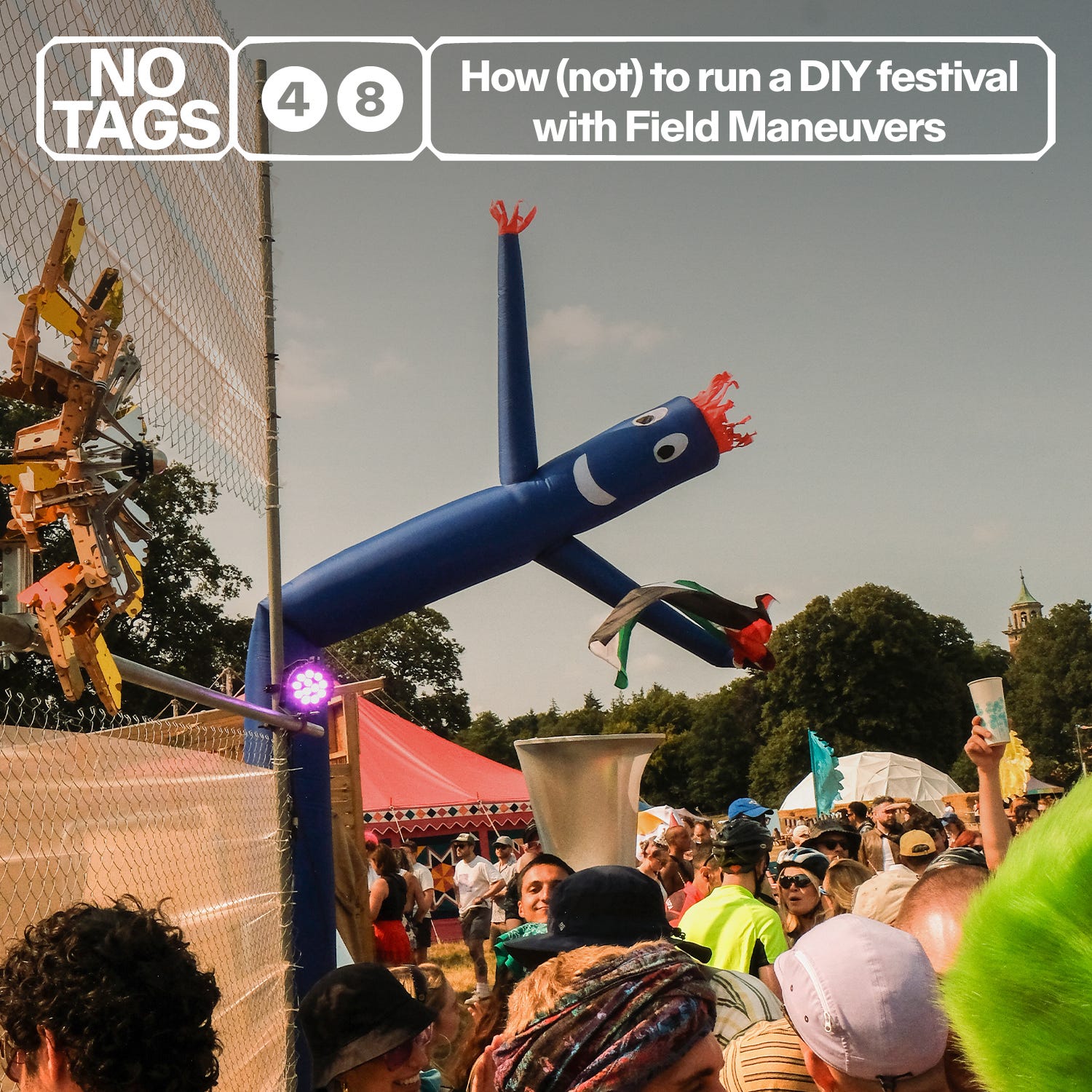
We talk about festivals a lot on No Tags, and usually the negative side of the circuit: the monopolisation, the immoral ownership issues and the overpriced cheesy chips.
But good can still prevail, and are hopes are pinned on Field Maneuvers: an LED beacon of hope in the darkness, and an event that puts the comfort and enjoyment of ravers first. Perish the thought!
It’s notable the FM crew often avoid using the word ‘festival’ to describe their three-day event in rural Norfolk. The current tagline states, ‘FM IS A NO FRILLS RAVE (now with a few frills)’ – but it’s previously been billed as a ‘dirty little rave’ and even, paraphrasing the Simpsons’ Comic Book Guy, ‘Worst. Rave. Ever.’ And it definitely doesn’t count as ‘boutique’ (though we’d argue that a festival with slot machines is its own sort of boutique).
In this episode, FM’s Henry, Ele and Leon explain how they’ve just about stayed afloat for 12 years – or is it 13? They can’t quite remember. We talk about building a rave utopia from scratch, the influence of free party culture on FM, adapting to festival life as new parents, and the momentum behind the current boycott of KKR-owned festivals. (We recorded this episode the week before Field Day.) There’s also a story about the time they nearly called off the festival due to excessive amounts of duck poo.
Before the interview, Chal and Tom chat about the lack of muckracking journalists in the music industry, following on from the latest First Floor newsletter, and get into some of your emails on side-of-stage access, the babushka hood craze, Afrohouse and Keinemusik. We’ve had some golden feedback emails lately – please keep them coming!
If you’re a fan of No Tags and want to show us some love, please do drop us a like and follow on Apple Podcasts, Spotify and Substack. We’re both list-pilled content-o-holics at heart, and any metrics that push us up those charts… well, we just love it. And if you really like what we’re doing, please do consider subscribing to our paid tier, which costs £5 per month. Planning, recording, editing and transcribing these regular podcasts is a pleasure but it’s also a lot of work, and your support truly does make a difference.
Photo: Maddie Moore
CR: The headline here is that FM died last year. It was a tragic event. There was a group of mourners dressed in black who held a funeral – they had a gravestone. There was a real sense that this great thing which everybody felt very connected to had ended. But you didn't die! So the obvious first question is: why did you feel you had to end FM last year, and how did you decide to resurrect it and keep going?
Henry Morris: Good question. FM provided us with an awful lot of stress over the years and a lot more problems than we ever expected to encounter when we first started out. Going into last year's event it was very stressful, and we reached the conclusion that the sensible thing to do was to bow out and take a step back because we lost our energy for it.
Ele Beattie: When you start putting on a party, you do it because you want to put on your dream party and you've got all the energy in the world to create this beautiful thing. And as we know, the festival landscape has become trickier and trickier. Last year [we crossed] that point on the axis of how much fun it is [compared to] how much stress it is.
HM: And we far exceeded it.
EB: The plan was to go away and come back with something smaller, where essentially we could party at it a bit more. It was a very selfish move. It was about making sure we have a nice time at our party.
HM: When we started out, we used to party at our party. We wanted to get back to that. But then we did our last party in its current form and it was so good, and we had fun at it despite all the usual problems, and there was so much love coming our way, that we thought twice.
Leon Cole: We'd been held hostage by the event, because we sold our tickets for 2020 back in 2019 and then that event had been postponed for three very stressful years. So we had this event that we had to put on, and then that lost so much money that we had to put another one on, and then we reached a point where for the first time in about five years we had a choice about whether to put this on or not.
EB: I think every promoter recognises that, right? When you're like, oh shit, do we have to put on another party just to make up for the last one?
TL: I think that's very familiar. For those who haven't been to Field Maneuvers, such as myself, how would you describe the festival in its current form?
EB: It's hard to describe a party because, you know, it's a feeling, right? Ultimately the best way for anyone to understand what FM is about is to come and experience it. But for a long time we used to call ourselves a rave because it was such a bare-bones party.
HM: I feel like it's unrecognisable from the first one we put on, but in a really good way. But it's organically grown. It feels like quite a special space once it's on. There's no judgement or any sort of... I don't know if you feel pressure at a mainstream festival, but [at FM] everyone’s just really cutting loose and feeling free to do what they like. It's what we've always tried to do, and it still is. I think people appreciate that in this sort of saturated market. You can just come to our party and be yourself.
EB: I think it comes back to our cornerstones, which are excellent DJs playing excellent music on excellent sound systems to a great crowd. Those are the main cornerstones. And how do you cultivate that? Yes, you can book great DJs. You can get great sound systems. But then you've got to cultivate the community.
In a a previous No Tags episode you were talking about what makes a good party, and we think about that a lot. What are the elements that we need? As much as it's about having an excellent lineup and great takeovers, things like having very hands-off security really enhance what we're trying to do at FM. Having clean toilets for people to use are equally as important in our party.
TL: Big one, in my opinion.
CR: There's no showers though.
HM: That might be changing.
CR: I quite enjoy the commitment to no showers, it freaks a few people out. Could you describe what's actually there in the field? There’s Sputnik, the dome-shaped stage. There's the pub. There’s the Pacifist Techno Sanctuary. Could you give us an idea about the different zones?
LC: I guess we started by trying to replicate our favourite bits of nightclubs in a field, which is where the stages and designs came from. The main priority has always been creating these immersive dancefloor spaces, which is all we focused on for the first five or six years.
EB: There's Sputnik, which is a big geodesic dome filled with lots of smoke and lasers. It's had lots of different sounds in there over the years. Ben Sims doing his Machine parties in there on Friday night sets the tone. It's quite an intense space – in the early years you used to have to crawl through a hole to get in there. Then it's full of so much smoke and lasers that it’s quite a disorientating space. Over the years it's grown a bit bigger and you can walk in it now instead of crawling into it, but that's been a long-term fan favourite. Saturday night is always very old school, whether it's jungle or hardcore, that vibe. It's got a real identity.
Then we've got the tent which has never really had a name, but it's the main tent – we've had a few names which have never stuck. That's where we've had the Dalston Superstore takeover on the Sunday for many years. It's a big blacked-out tent, very hot and sweaty. One big element is having two big screens where we get lots of visual artists and VJs to come and put their mark on it. Shout out AVVA Studio who do the Sunday night visuals. When their visuals and the House of Slopulence dancers all come together on a Sunday night, for me that's the essence of FM. It's all the perfect moments coming together. What else have we got?
CR: The pub!
HM: We've really nurtured that. We've got a dartboard in there. We've got a lock-up full of fruit machines, which only get wheeled out once a year.
EB: And some of the fruit machines pay out more than they take.
HM: In the early years it was our [idea that] this is the one thing that's going to make us money, and it turned out we bought a fruit machine that paid out more than you put into it.
EB: This is Leon and Henry's area. They're the fruit machine engineers. Their aim was to somehow fit fruit machines into our party, so we had to build a pub to legitimise it.
TL: I actually bumped into Jonny Banger shortly after the last edition of FM last year and he was like, ‘There's fruit machines, it's great!’
EB: It's a big selling point.
CR: And what about this chillout area?
EB: I think that's changing form this year. How many years have we had it? I'm not sure. A lot. It's something that we booked ourselves and then Miro sundayMusiq, who runs Netil and does the Pacifist Techno parties with Suniman, took it over and has been curating that for the last few years. It's taken a lot of different forms. At one point it was a 24-hour chai tea tent that we put our DJs in. Sadly those guys can't make it anymore, so it's been evolving. I think this year it's going to be something quite different to what everyone expects, but it's a nice little 24-hour spot. Once the music finishes there's a big puddle of people chilling out until the next day.
CR: That particular stage feels like, you know, the wheels are off. You get talking to people and it’s a vortex. The freedom of that is really hard to achieve in a festival.
EB: Yeah, there's been a lot of weird stuff happening in there over the years. Part of the reason FM started is because me and Leon went to a lot of formative festival experiences together back in the day. There's the Lunched Out Lizards [stall] from Glastonbury, which is a spot that we turned into our own after-hours ambient tent for many years. It’s like a 24-hour coffee spot, and I think that lounging vibe there is a bit of an inspiration for what the ambient tent has become.
But it's an evolving thing. A lot of our stages have very defined personalities, and that one is forever changing. Will it be its final form this year? I'm not sure yet, but it's going to be quite different. Think more like a chillout room at a rave in the noughties.
CR: Ooh. Oxygen bar?
EB: Yeah, without the oxygen.
Photo: Celine Antal
TL: Is there anything that might particularly surprise someone going to their first Field Maneuvers?
EB: Lots of other festivals have a big team behind it and they really show you what the festival looks like online – videos of it really popping off in a tent. We don't do that so much. We really want our crowd to trust us that they're going to have a nice time. Especially in those early years when we were basically asking people to buy a ticket to a party that had no history, and we were doing it on a wing and a prayer.
You've just got to trust us that you're going to have a nice time. It isn't going to be the most polished experience in the world. It isn't going to be like other festivals you've gone to where you've got showers. You haven't got a place to lock up your stuff. But you've just got to trust us and come and have a nice time and get into it. So I think we're asking for a level of trust from people, especially new punters.
LC: People used to be very surprised at how small it was, but we've done a lot to manage expectations with stupid slogans, and this rave messaging which was a reaction to people turning up being like, ‘Wait a minute, this isn't a festival – you haven't got bands or a stage or anything.’ I think [we’ve done it by] combating the ‘boutique festival’ messaging that people were describing festivals as when we launched.
EB: Yeah, we kept getting called a boutique festival. Don't expect that when you come. Then we had the tagline ‘dirty little rave’. I think we were nominated for ‘best boutique festival’ and we were like, ‘oh – we're just a dirty little rave.’ So that was our tagline for a bit. In fact, No Tags Alfie [who designed FM’s stripey rave visuals this year] pointed out to me that we have a very self-degrading set of taglines. ‘Hanging on by the skin of our teeth.’
HM: ‘Run by idiots.’
EB: Yeah, that was a very early one. What else?
CR: ‘Worst rave ever.’
EB: Yeah. ‘No frills rave.’ I think we're trying to keep people's expectations really low so that when they come they're like, ‘oh yeah, it's actually pretty good.’
TL: Take us back to the very first edition. How do you look back at it?
HM: I can't believe we pulled it off. We had no idea what we were doing. We didn't have any money to set it up. We had no system in place for people to buy tickets. I don't even know how we publicised it. People had to transfer money into Ele’s personal bank account. We had to cross-reference it against a spreadsheet. And then we just arrived in a field without any bins or water and put some tents up, and realised we had to put up the whole fence ourselves.
There was only five of us doing it. We didn't have any sort of waste clearance set up. We were just expecting we were going to party at it the whole time, which we did, and had next to no sleep and somehow got to the end of it, in between doing runs to the local cash and carry to get more booze for the bar that had just run dry, and punters were sort of verging on rioting because there was no booze to drink. It was absolute chaos. We didn't have an office, we were doing everything, all the artist liaison, out of the back of a tent – which was tiny, we couldn't afford a decent tent. I've no idea how it got to year two.
EB: In the third year when we eventually got like a port-a-cabin to run it from, it was a real landmark moment.
HM: We had a long meeting about whether we could afford it or not and I was dead against it. There was no way we could afford an office. Absolutely not.
EB: It had a school fete vibe in that first year.
HM: [Laughs] Not like any school fete I've been to!
EB: Some really very flimsy marquees.
HM: We had a very big post-event party to celebrate how disorganised we'd been and then crawled out of our tents two days later and just had a field of rubbish which we then had to clean up ourselves.
EB: There wasn't much foresight. But then also, correct me if I'm wrong you two, but if we knew what we know now, would we have done it?
HM: No.
EB: I think when you're in your mid-20s and you're quite ballsy and super naive about this stuff it's great, because you're just like, I'm just gonna do this thing which I don't know how to do. I mean, Leon has a history of running venues, I was working in the music industry at the time, we sort of roped Henry in, and our other friends.
HM: I went to a lot of DIY punk [gigs] in my late teens and then loads of squat parties in my 20s, so I was very much surrounded by a DIY ethos, and you just get up and do the party you want to do. So I was into that, but if I'd have known how much work it was going to be, we wouldn't have done it. I'm glad we didn't know how much work it was going to be.
TL: How big was the first instalment?
HM: About 350 people trusted us? 350 people put money in [Ele’s] bank account.
LC: We ran 24 hours for the first four or five years. While we were on a temporary event notice we were just like, well, we've got the licence – let's just roll through.
EB: These are the perks of a temporary events notice, which is basically the notice you need to put on a school fete. You can have a gathering of up to 499 people. It's got so much grey area in that events notice that you can do stuff like have 24-hour music. I remember when we finally realised we could sell more than 500 tickets and we were like, [gasp] ‘we're gonna have to do this by the book now. I really have to figure out how to put on a proper party.’
TL: How has the music changed over the years, and how has the crowd changed as well?
EB: In the first years it was very much like who can we enlist to do this. Then all of a sudden we were like, actually, maybe we can pay people that we really want to come and play. Not that I'm saying that we didn't want those people in the first year to come and play too, we did! But it's evolved to fit our taste more.
Also there's lots of people who have been involved from really early, like Mark Archer and Ben Sims. [They] just came and really enjoyed the party and then wanted to be involved. We've sort of snowballed and accumulated nice people along the way. Leon used to work at Dance Tunnel back in the day and that's where we picked up – well, enticed – Dan Beaumont down, and then that developed over the years into the Superstore takeover, which I feel like is a really big part of what FM has become now.
Photo: Celine Antal
CR: It's really noticeable what a mixture of crowds it is – not a mixture in the sense that they don't go together, but the fact that you have such a big queer celebration on the Sunday and it just feels like a natural extension of having someone like Chris Liberator in Sputnik the day before. Historically they might be seen as two quite different rave crews, but the way it all mingles together is one of the things that makes it a unique festival. That must be something that's evolved a little bit.
HM: I remember, I guess, in the third year or fourth year walking outside and not recognising anyone at all. The first few years you knew everyone who was on site because they were the people who'd come to do it. It's kind of a testament to the party we've created that it feels like such a welcoming, fun, open space that the crowd is what it is now. It feels like we promise a good time and only people who want a good time turn up.
EB: Who we work with and who we decide to collaborate with is such an important part of how we've cultivated this community. How do you cultivate a nice community? It's a really difficult thing. When you get bigger festivals than us, like, you just want to sell your tickets. You just want bums on seats, right? But who we work with for takeovers, whether it's Superstore or Black Artist Database or having the Pacifist Techno Sanctuary, trying to find groups of like-minded people and inviting them into the wider family is how I think you create a crowd like that. Your example of Chris Liberator or Sharkey on one day and Superstore the next day, and the contrast there – I love that we can have that.
There's been times when people have approached us about potentially having a whole tent that is a queer space, and as much as I think that's a great idea at large festivals like Glastonbury, where I think it's really important to do that, I also love that at Field Maneuvers we have all these different elements but it is still very much a unifying space for lots of different people to come together. If we started having different tents for different groups I think it would lose that element of the unifying joy of getting people together from all different walks of life to let loose.
TL: We had Frankie Decaiza Hutchinson on No Tags last year and we talked about Dweller [the NYC festival celebrating Black dance music] and how much bigger it could potentially get. She'd basically concluded that there's a limit on how big it could get without losing what makes it special. Do you think there's a natural cap on how much bigger FM could get without losing that essence that you're talking about?
LC: We're trying not to push that boundary, I think. We've only ever really grown because of financial constraints. So every year we realise that we need to have more of something and therefore we need to grow slightly in order to afford it. We've pretty much reached a size that we're happy with and is maybe sustainable. We haven't discussed any massive growth plans so I don't think it's on the cards.
EB: From something that people fell in love with as a party that was 500 people, even the size we've grown to now feels like quite a big jump.
HM: Yeah, we've already had some complaints that we’re too big.
EB: At 1,600 people, some people are like, ‘whoa, it's not like the old days.’ But yeah, I agree. Some of things we fell in love with that have inspired FM are either like those little corners of big festivals or other small events, like Freerotation definitely was a big inspiration.
HM: I don't think any of us want it to get any bigger, do we? We're not hungering for it to be a huge event. This is the size it is we're very happy with. The thing that drives it all is making sure everyone has a nice time. Bigger doesn't sound like a nice time.
EB: In the early years everybody would know each other one way or another. And now, you know, Friday night, everyone's coming in and partying and by the time Sunday comes I'm like, ‘so-and-so, you should meet so-and-so,’ and they're like, ‘we've been partying together all weekend’! I love that by the end of the weekend it feels like everybody in that field is less than six degrees of separation from the person they're dancing next to. I wouldn't want to lose that.
TL: On No Tags we're constantly glorifying the independent operators in music, whether that's festivals or labels or record shops or whatever. But what's the reality of being an independent DIY festival like Field Maneuvers? What actually makes it tough to keep doing this?
HM: All of it. [Laughter] The money. The only reason we're as big as we are is to get enough money to keep it sustainable. We're carrying debt forward every year at the smaller levels. As Leon touched on earlier, we've reached a sustainable level, but we're not in this for the money. We're not here to scale up and make as big a score as we can. It started because we wanted to have a good time and we're still doing it because we really want people to have a good time.
There’s zero financial incentive for us to be carrying on doing this. We’ve all got other jobs and other responsibilities. But it just feels like a good thing to be doing in the current climate when so much good stuff is falling away. We’re still hanging on. We owe it to people to carry on.
LC: I think in 2014, when we made £300 profit and spent it all on sushi, we thought we’d nailed business. [Laughter] Then the following year we lost money, and then we lost money every year until 2019, I think. So we've just been growing in order to reach that critical breakeven point where it is sustainable. Now we've kind of got there, but it’s still pretty nerve-wracking financially. This is going to be our first year we're going to have cancellation insurance, which basically means that every event so far has been us rolling the dice on British weather as to whether we'll go bankrupt or not. So there's a lot of pressure on the event.
HM: It's hard to describe the knot in my stomach I carry around about this time of year onwards, about whether we're going to sell enough tickets quickly enough before the event to pay all the suppliers and contractors. Just on top of doing the school run and my other jobs and everything, it's just there the whole time. And then when the event's on, is the bar going to take enough money for us to be able to pay everyone afterwards? So far, so good. But it's just constantly nagging at you.
EB: You don't get into this thinking, ‘oh, I can't wait to get really good at spreadsheets.’ You get into this being like, ‘I want to put on a really great party.’ And then you have to figure out how to do all the rest of the stuff.
HM: You have to find out how to do a VAT return.
CR: One upside is that all these interesting situations and scrapes do make for quite good stories afterwards. Is there something that perhaps you smile about now, but at the time it was terrible?
EB: I think the biggest one was doing the crowdfunder after Covid.
HM: Does that make you smile?!
EB: Well, it was really shit. That situation of putting on our first party after Covid and having to keep the festival going for two years, and then thinking we'd sold out but lots of people not turning up. Basically putting on an event for 1,600 people and 1,000 people being there, not getting money, and being like, shit, we've got to figure out what to do here. We launched a crowdfunder… awful, most horrible feeling. But that strengthened our community more than anything, and it made us realise that people really valued this party and that it was worth doing. All the stress we just talked about, it is worth doing, because it is a really important thing to lots of people. So yeah, that's a bigger one. There's lots of more small embarrassing stories.
HM: The year we forgot to get any water was memorable. I don't know if it casts us in a good light or not, but it hadn't occurred to us that punters might want water. I think the plan was to just leave some two litre bottles around the field.
EB: No, the plan was to drive off to Maz’s – shout out Maz and Julia, who started this with us and then were wise enough to get out of the game – but it was to drive to Maz's house, which was five minutes down the road, and fill up these small bottles of water and then bring them back to the punters. But yeah, we’ve figured our shit out since then, a bit.
Photo: Drew Eckheart
CR: I know that running a festival alongside a life and a job is just really difficult. You've got a lot of people working for probably half a year on something that might ultimately make no money, or lose money, and then you've got to carry on the next year. How much of your life does this festival take up, and what sort of proportion of your income can it provide?
LC: We don't give it enough as much of our lives as it's due, really. If we had more time to put into it, it would probably be a slightly less chaotic beast. But we have to squeeze it in around our other jobs and stuff.
HM: I mean, from now [early summer] onwards, it takes over pretty much everything. It's like another full-time job. Earlier in the year it's maybe a day a week, or half a day a week, November through to February. But in terms of income, negligible. Completely negligible.
EB: Yeah. This has been a labour of love, and not just us putting in our time to work on it, but so many of the people who’ve worked behind the scenes for a really long time. I think we've paid all of our crew for the last, I don't know, five years.
HM: We’ve paid them from the start!
EB: But there’s so many people who are going above and beyond. People who are happy to come and be involved in this party to make this thing a reality, and will give up their free time throughout the year and on the weekends. It's a very collective effort – it's by no means the three of us.
HM: Yeah, we rely on a huge amount of goodwill. But actually now we do pay everyone who comes on site and works, but not ourselves really.
TL: What are some of the rules and regulations that you’ve had to navigate or adhere to? It'd be interesting to hear about some of the bureaucratic obstacles when it comes to running a DIY festival.
LC: We've had loads of really expensive obstacles. When we grew to over 500 capacity and had to get a premises licence back in 2015, they decided that we had to have an off-road fire engine on site. Every time you go for a new licence they like to pick a little hole in your event management plan. And we were quite green and naive in those days so we just acquiesced to the things they asked. So yeah, we've had fire engines. We have a giant hoover that comes on site currently to suck up all the animal droppings on site.
CR: Wow.
LC: We spend seven grand on hoovering the whole field before anyone arrives on it. We almost didn't go ahead a couple of years ago because of duck shit all over the field, or goose shit. So now we have to employ this incredible contraption to come in and suck it all up.
TL: Can we get a visual here please? Is it a team of people pushing a gigantic hoover around the field?
LC: No, it's tractor-driven.
EB: A tractor-driven giant hoover. But before we got the tractor-driven giant hoover we had to employ a team of people to basically come and pick up poo. When environmental health turned up and were like, ‘oh, there's a lot more goose poo here than we thought there would be…’
HM: Or was it sheep shit?
EB: Maybe it was sheep shit…
LC: Basically they turned up on the day we were going to open and said, ‘your festival is not going ahead.’ And I was like, ‘leave it with me.’ And I just ran around the site with a big pile of all the site cash and was just going up to anyone who had the day off and was like, ‘right, 50 quid if you go pick up shit, 50 quid if you go pick up shit.’ We had a team of everyone going across the site, hand-picking up poo.
EB: Including the kids of the family who own the estate that we have it on. They were like, ‘we've heard there's a poo problem, can we help?’ And they were really sweet and just came and picked up loads of shit.
CR: We've all spent the past five years talking this particular topic to death, but from your perspective, what have the long-term effects of Covid been on running a festival?
LC: I mean, we're still paying back our Covid bounceback loan. I think most independent festivals are still saddled with debt from that period, which given all the rising costs, and the cost of living crisis’ impact on ticket sales, I think everyone's kind of struggling to right themselves financially from that. I think that's really what's holding down the independent festival sector at the moment.
EB: This might be the year that we pay off our Covid loan.
HM: No.
EB: No, it's not, OK, I lied. [Laughter]
CR: Steering in a slightly different direction then, I wanted to talk a bit about the political backdrop to this rave, and all raves. I have often seen Henry wearing his Redtek t-shirt around the site – Redtek is a socialist sound system based in London. I wonder how you see what FM is doing in relation to free party sound system culture?
HM: That's a really good question because I've been thinking about it a lot recently. Raving, early free parties, the big Castlemorton raves and things like that, it was all really celebrated because it became a sort of political amnesty. You left your political views at the door and you took ecstasy and you had a big rave and you had a big party. And where we've got to now, the natural progression of raving, is commercialisation. Festivals like ours now are trying to push back against it a bit.
We're using our platform to express our political views. I find it difficult to strike the balance between being a place where you want people to come and just let go and have a party, and then also hit them with messaging saying, ‘this is what we stand for, this is what we think.’ Luckily, Ele and Leon and I agree on most of the political things we think about and are happy to use our platform to speak out about Palestine and things like that. But there's a slight tension between… we're a rave, but in in the background the world is full of dreadful things going on, and how much do we want to steer our rave into talking about those problems? I don't know what the answer is.
EB: Yeah, and we definitely didn't start as a party with morals, as it were. It did just start as a party. But as it's evolved, whether we've grown up or it felt more important to share our viewpoint, or the world has got a shitter in many ways, but even if it's employing great people like Camp Trans to run our backstage food so that we can then help them make money for their festival, or just who we align with… We haven't got much control in this world of ours, but whether it's trying to implement better things in your own workplace or where you spend your money, we've got this chance to create a tiny little corner of the world with FM. I don't want to call it a utopia, but it's our chance to promote the world that we would like to see on the outside.
HM: I think Redtek are brilliant, and they are out to change the world and they know what they want to do, whereas I think in contrast to that we want to create an example of how the world could be. So instead of telling people how to do it, just create an example of how we want things. Utopia is quite a wild word, but we could all be really nice to each other and have a nice time all the time. Wouldn't that be a turn up for the books?
I've been reading about the Battle of the Beanfield, which was when the police smashed up the big Stonehenge Free Party in 1985. I'm doing a bit of research about that, and it really strikes me how much freedom has been lost. We've got the Crime and Policing Bill now, which we're railing against, but back in 1985 you could move around in a free-party convoy and live on a festival circuit that existed all year round and go from weekend to weekend across the summer living out of your converted mobile home in a kind of alternative society.
That was completely crushed by the Tories as a political statement when Thatcher sent [the police] in. They brutally attacked all these proto-ravers and destroyed the movement. And then on top of that, the Criminal Justice Act in 1994 further limited people's ability to congregate freely and do what they liked. We've lost so much freedom since then. It's important to demonstrate that actually people can come together, do things which aren't necessarily socially acceptable, or socially normalised, and still flourish from it, have a great time and then come away empowered.
CR: We watched the Free Party documentary in Sheffield last week when we were talking to Grace Sands before the film, and the footage is a type of FOMO that's just really deeply painful. I'm always interested in whether a festival or rave can attempt to create even a temporary zone where people might bring that same feeling of freedom, of not being surveilled, not having security around them, and so on.
HM: I think we might occasionally create those moments, like on Sunday night with Dalston Superstore’s takeover, or on the Outside stage where it's completely unified and you've just forgotten about the rest of the world in a very non-commercial way. But I don't think we'll ever capture what it was like at Castlemorton or Stonehenge in 1984.
CR: We were talking the other week on the podcast about vibes and atmospheres created on dancefloors. What have you worked on to enhance vibes over the years?
LC: I guess hiring the best welfare teams and the best security teams you possibly can is so crucial for this. Until we found Gawain and Emma and our security team we really struggled, and until we started working with PsyCare and now Safe Only as well. Now we've got this team of three organisations in place, people really feel like they are secure and looked after but without ever feeling like they're being checked up on, which is the crucial balance that's always getting done wrong, but it's really hard to do.
EB: In the first few years the security teams we found were local security. They weren't awful but they weren't the most welcoming presence when you arrived at the festival. I've worked at big 40,000-capacity events, and sometimes you're in a tent and the security is leaning over and you feel like you're being surveilled. They're a presence in their high viz and it's something that you can't fully block out. We've got this amazing team and lots of their crew are ex-ravers or have worked at very small parties. If we need them they are amazing and they are on it. I think in our history we've only ever had to chuck out two people. Is that right?
HM: Three.
LC: No, there's been a few more than that…
EB: And [the team] were so great and amazing but also so hands-off. They're not ever in the tents, they're not a presence around the festival where people are partying and letting loose. That's quite an important factor that's been there from day one for us.
HM: In terms of the intangible bit, I don't know if I'm bigging us three up here, but the first four or five years we really got stuck into the party at the same time as being at it, until it got too much. But all the people who've worked with us since the start have seen us doing that and they appreciate we're here to have a good time and we don't take things very seriously. While we personally have had to take things more seriously, that crew of people around us set the tone for the party. Whether they're talking to the stewards or interacting with punters, they're letting people know what the vibe is here. And I think that's snowballed and people know it's a safe, fun space. There's no pomposity or anything like that.
CR: How difficult is it to have a security that's operating in that way, in terms of how the council or police oversee what you're doing? Can any festival be running in that way if they want to? Or do you feel like you've had to build up trust with local authorities in order to operate in that way?
LC: We have a security plan that uses different teams for different things. Our security team is mostly working on access control to make sure that the right people get in in the right way and the wrong people don't. We've got eyes everywhere. We've got Safe Only dance floor stewards who are SIA accredited [for private security contractors] and they can deal with what's happening on the dancefloor to make sure everyone's safe in there. So in terms of council approval, we tick all the boxes but we just make sure that we're deploying the right teams in the right places.
HM: I think because we're so hands-off we haven't had any trouble. And as such the council don't pressure us and say, ‘you need to have more security there because you have so much trouble.’
EB: A big thing that we've done since the beginning is having a 21-plus age requirement for the festival. So everyone who comes to FM, they're usually seasoned ravers. It's definitely not their first party. I think having a crowd who know what they're doing rather than the young guns who are balling up being like, ‘right, let's get into this,’ really creates an atmosphere where the partying is very respectful.
TL: How do you view the UK's festival landscape and where it’s going?
EB: It's pretty dire isn't it? There's been so much change. There's such a separation between being a big festival or an independent festival, and obviously the conversation which we're probably going to lean into with Superstruct, it's not looking good, is it? Festivals started out of this desire for counterculture and free space, and it's very quickly become big business.
HM: The financial pressures on small independent festivals are so high and we're all falling by the wayside. Whatever's left and successful gets hoovered up by the big money. So it's all going one way. But I don't know, in times of political strife and turmoil, counter-cultural movements come out of them, don't they? I think there's there's always going to be a space for people who don't want to engage with capitalist ideas of what a good time is. But yeah, the festival landscape is dire.
EB: I'm really curious to know where it's going to go. [There were] 145 festivals cancelled last year. What is going to happen to Field Day and Sonar? How do these KKR-owned festivals come out of this? I don't know. What is the landscape going to look like in a year or two? I can't quite see it yet.
CR: What are your thoughts then on artists boycotting KKR-owned festivals? Do you think it is strategically useful and sensible? And/or morally right and good? Do you feel like there's gathering momentum around this?
LC: It'd be nice if there was, but I really don't know what the end goal is with this really, because they're not going to be sold to independent operators, these events. I mean, they could get sold by KKR, but who to? It's going to be part of some VC portfolio somewhere, isn't it?
EB: It does feel like the pressure is picking up. I do generally feel very sad for lots of these festivals, or the people who are running them, who started out with really good intentions and have had absolutely no control over who has ended up buying them and now find themselves complicit in something that probably doesn't align with their values. I sympathise with them. You're working really hard to curate this event but now you're being tarred by this brush of your incredibly evil owners. I mean, I've left jobs for much less bad things than being associated with that company, but where do they go? It's no fault of their own. Would I carry on working at one of those events? I probably couldn’t.
With artists, I think it's great that these artists are using this as a chance to remind people what they believe [in] and [to] stand up for what is right. But where is it going? I hope it snowballs into something, but where's the pressure? We've seen all these very hollow statements that have been coming out from all the festivals in these last few days. If that's what artists boycotting this event is going to result in, at the moment, that's not enough is it? So where is it going to go?
HM: I'm not about to judge any artists on whether they do or don't, but personally I feel you've just got to do what you think is right, because if you look back and think you didn't, then that's on you. Even if what you're going to do might not have any impact at all, at least you tried.
CR: The reason that Field Day and Boiler Room in particular are caught up in this is that they've been sold twice, right? They've been sold to someone who sold them to someone. And now, like you say, you have a whole team of people working there who don't recognise this type of ownership, who maybe don't want to work underneath companies with those values, specifically with private equity. Just curious, have you ever had any interest from anyone looking to snap up FM?
HM: Zero. [Laughter] Though we did say earlier we'd sell out for 50 quid and a packet of Frazzles. But no, we haven't been turning away briefcases full of money at any point.
CR: It relates back to what Tom was saying about this pathological sense of needing to grow. If you've grown enough, there has to be an exit strategy. If you've put this much investment in, then you have to get a return on that investment and a sale has to happen. And of course, once you've sold it is the end of whatever vision you had for that company.
HM: I think it's just the nature, the insidious nature of capitalism that's just the instinctive way that we all think we have to behave, to make as much money as possible and sell out. We always lose sight of the fact that things can be intrinsically good for their own sake. It doesn't have to have loads of money sloshing around it. It's just good to do something that makes people happy. That's never factored in as something that's important to people.
TL: Going back to what we're seeing with Field Day at the moment, when we were talking about Boiler Room on the pod previously we were saying that if a significant amount of artists started boycotting, it could reach that critical mass point where it reaches mainstream news and makes this whole issue visible enough that people start to reconsider where they spend their money when it comes to live music. My instinct was that it wasn't going to get there, but with what’s happened with Field Day in the last couple of days, I do wonder if we're now actually reaching a tipping point where the majority of that lineup might pull out.
HM: I guess you get to a point where the people left on the lineup start feeling very isolated and exposed.
EB: And I personally wouldn't want to spend my money there and go to that party now. Would I be able to have the wild abandon that I'm hoping for at a festival knowing where I'm putting my money? No.
LC: Would you at Field Day anyway? [Laughter] Probably not.
TL: Someone like Midland or Mall Grab pulling out, those are significant acts. There's now going to be people at wanting refunds because they've booked their tickets to see them specifically.
HM: Even if it doesn't get there, switching on the minds of less politically engaged people who were excited about seeing Midland, but are now wondering why he's pulled out and then investigate – it's a very positive thing he's done.
LC: Definitely. It would be great to see some kind of collective action as well with statements about what's going to happen in 2026. All these artists who pulled out, and even artists who might get booked in the future, could sign an open letter saying, ‘we will not be playing next year.’ And then everyone who's buying tickets will be like, well, none of my favourite artists can be playing at any of these events. And that could actually change the revenue for KKR much more drastically, because they've already sold their tickets for this year, I imagine. Individual action will only ever get so far.
TL: On a very different note, some of you are now parents. That obviously hasn't stopped you continuing Field Maneuvers. We had Derrick Gee on a previous episode, who has a young child, and he claimed that having a kid has actually given him the extra energy to keep doing what he's doing. How have you found running FM with young children?
EB: Logistical nightmare. That’s the hardest thing to wrangle. That's our most common Field Maneuvers chat at the moment, ‘who's gonna look after the kids?’
CR: Leon, do you have kids?
LC: No, but I do have to debate the budget line for childcare.
EB: [Laughter] Massive shout out to Leon that he is up for putting childcare in our budget. Because the festival wouldn't happen if we didn't have someone very kind to come and look after our kids.
TL: Mum and dad need their annual blowout.
EB: It's funny, talking to our daughter's friends at school, in rural West Wales, a lot of her friends' parents are farmers. They're like, so it's a party. What are people doing until four in the morning? It's very far removed from what life is around here.
HM: From the local agricultural shows.
CR: So what is new at FM this year, what should people be excited about?
EB: Something I'm really excited about this year is having the Hyperdub takeover. Kode9, Cooly G, Ikonika, Nazar, aya. Just an amazing lineup. It was a very iconic label in my formative years, they've been doing it for 20 years more now, and it felt like a real landmark moment when Kode9 played two years ago as part of the Touching Bass takeover. In terms of our installations, a few years ago we had this big mirror wall on the Outdoor stage, really beautiful. Parker Heyl, the artist who designed that, couldn't come last year but he's back this year and it's a beautiful kinetic stage that is moving mirrors, and it's beautiful and sparkly and it's by the lake.
HM: Got a darts tournament. Bigger and better than last year. It's going to run for two days.
EB: That was very popular, the darts tournament last year.
HM: It's huge.
EB: There's a cup now and everything, so you can win that.
TL: And you said you weren't going to expand.
EB: What else? Iona's takeover is going to be great this year. So Iona, core member of the Field Maneuvers family. She's played every single stage over the years. I think one of the few returning artists who's played every stage. She had a takeover in Sputnik last year which was amazing with Jeneen, LCN and Djrum. This year she has got Yazzus and Paurro.
TL: Final question, as ever: all three of you please recommend us and our listeners a film.
HM: A film? The Rock.
CR: Do you know, I'm amazed we don't already have The Rock on our running guest recommendations list. That feels very pure to me.
HM: It is what it is. Leon and I have been known to escape to watch it whilst at Field Maneuvers, to unwind.
LC: There's quite a canon of Field Maneuvers movies that you watch when you're a bit overstimulated and need to hide in your caravan for a bit.
HM: Under Siege.
EB: All very relaxing movies.
HM: Executive Decision. Dreadful films from the 90s.
EB: Henry knows every single word from The Rock, so there was a plan one year to show it at the festival with Henry commentating it. But it's never come to fruition.
TL: I've seen The Rock so many times in my life. I think it was just permanently on TV growing up.
CR: God, Under Siege looks like absolute bullshit.
HM: You say that, but when you find yourself on a ship and the cook's the only person who can save you…
EB: This is what these two watch when I'm trying to run a festival. I'm probably going to have to go with Labyrinth. It's an all-time favourite perfect movie in my eyes. It's got David Bowie. It's got Muppets, Jim Henson all over it. It's great. In maybe the third year of FM we had a cinema tent where we just took all our favourite movies and put mixes over the top of them. Labyrinth had P Relief from P&D Records, like a Beats in Space mix over the top. It was just so perfect. It was all timed very, very well.