


They say that if America sneezes, the world catches a cold – and you can be sure that patient zero is lurking somewhere in the Bay Area.
This week we’re republishing an essay that first appeared in our (sold out) 2024 book, No Tags Vol 1, with an update from its author, Chris Zaldua. As a DJ, promoter, writer and label boss, Chris can only be described as a stalwart of San Francisco’s turbulent-yet-undying dance underground, whose projects include the record label Left Hand Path, the blog Thoughts of a Certain Sound, and the parties Surface Tension and Vague Terrain.
DJ CZ also has a sharp read on SF’s rise/descent, as the city’s self-image as a hippy-fronted, tech-funded, chia-blended utopia gives way to some kind of self-driving cyber-Dickensian tent city held aloft by the Nvidia share price.
When he wrote his essay for No Tags in late 2024, Chris observed that dance music had become a multi-million dollar industry in the US, repackaged for huge crowds at marquee festivals via VIP ticketing packages.
Emailing us recently, he pointed out that all this is not only still happening, but happening much more. So we’ve decided to republish the essay with a new foreword from Chris, bringing us bang up to date on the SF doom loop.
Scroll right to the end for some reassuringly high-quality music from SF’s free party (‘renegade’) scene.
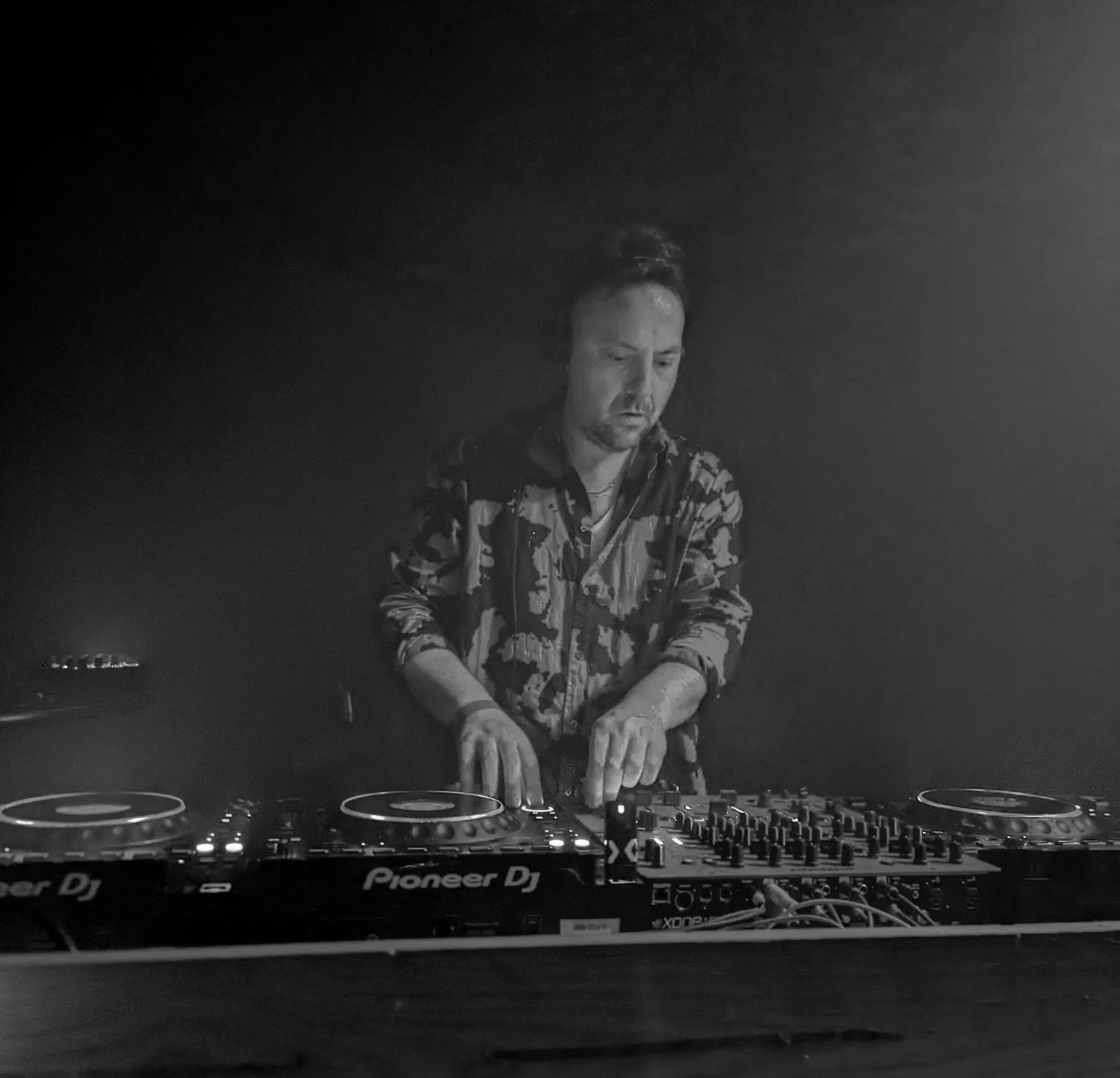
CZ: When No Tags commissioned this essay from me in October 2024, San Francisco was beginning to emerge from its “doom loop,” a hilariously shortsighted (but not entirely incorrect) viral narrative about lockdowns, remote work, urban abandonment, and the knock-on effects thereof.
As the city began to thaw socially and economically, it was our local corporate interests – particularly those born and bred of Silicon Valley – that took the lion’s share of the benefits, fuelled by a preternatural onslaught of venture capital into the explosive “artificial intelligence” industry. They don’t call this city a boom town for nothing.
Spurred on by this development – and the sell-out success of Portola Festival, a new electronic music festival for the masses produced by corporate promoter Goldenvoice – I tied various threads together into a ‘vibes-based’ essay that sought to capture what the City by the Bay felt like at that particular moment. Which is to say, extraordinarily challenging – but extraordinarily beautiful. (Same as it ever was.)
In the 18 months since I wrote this essay, the corporations are not only winning, they’re winning harder than ever. Our new mayor, Daniel Lurie – himself a billionaire – has sidled up to the mega-rich at every turn. A few examples: Chris Larsen, a crypto billionaire, has given $10M to the San Francisco Police Department with Lurie’s blessing. Another billionaire, Sytse Sijbrandij, is flooding the city with public art, nearly all of it Burning Man-derived, including an insipid 45-foot-tall statue of a naked woman. And Big Tech has gone full mask-off, cosying up to the imbecilic white nationalists of the 45th White House with unabashed fervour.
Meanwhile, Goldenvoice, the “quirky-indie-alt” subsidiary of the second-largest music promoter in the world, is now producing Club DARC, a “warehouse rave-themed” event series complete with $3,600 VIP tables and $30 cocktails. I might say that the jokes write themselves, but to the surprise of absolutely no one, Club DARC is a smashing success and Goldenvoice is laughing all the way to the bank.
As the bubble expands – to quote Speedy J – there will be winners, and there will be losers. Of course, we already know who they are and who they will be. Such is life in America in 2026.
Yet in spite of it all, the city remains stunningly beautiful, and pockets of weirdness persist, even today. And I am still here – for now. Thank you for reading.
The Business of Techno in San Francisco
It’s morning again in America, and the business of electronic music is booming. Dance music is more popular than ever, received by the masses in multi-room mega-club complexes, at city-sanctioned private block parties, and at marquee festivals with General Admission, VIP, and Deluxe VIP ticketing packages.
Sponsored Boiler Room video streams deliver the experience directly into our homes. On the portable screens we gaze into six hours a day, Instagram ads for DJs with 85,000 followers and names like ‘Retep’ and ‘Toozy’ invite us to ‘secret warehouse raves’ that end at two in the morning. It seems the future we’ve all been waiting for has already arrived – it’s just more unevenly distributed than we ever could’ve imagined.
How did we get here? For most of the past 50 years, dance music – disco, house, techno, and so on – found little purchase in America outside of the queer and non-white communities that forged them. Scenes thrived in Detroit, Chicago, New York City and out here in San Francisco, but with few exceptions, Americans ignored electronic music altogether. If they regarded it at all, it was usually with withering condescension (Steve Albini saying he ‘always detested mechanised dance music, its stupid simplicity’) or worse, a disdain that often stood in for thinly veiled homophobia (the legacy of Disco Demolition Night, in a nutshell).
It’s hard to say when the tide began turning, but Daft Punk’s mythical gig at LCD Soundsystem’s house was a starting point. Then came Daft Punk’s actual gig at Coachella in 2006 and their subsequent Alive 2007 tour, complete with robot costumes and larger-than-life neon-lit pyramid stage design. Those shows laid the blueprint for the brickwalled EDM schlock of the 2010s, which by 2012 had arrived at Outside Lands, San Francisco’s premier Coachella-like festival, as Skrillex, Justice and Wolfgang Gartner received top billing.
EDM, fundamentally indistinguishable from pop music, made sense in mainstream America. House and techno, built around subtle shifts in repetitive phrases and designed to be stitched together by DJs in long-form sets, never really did. Times are changing, though, aren’t they?
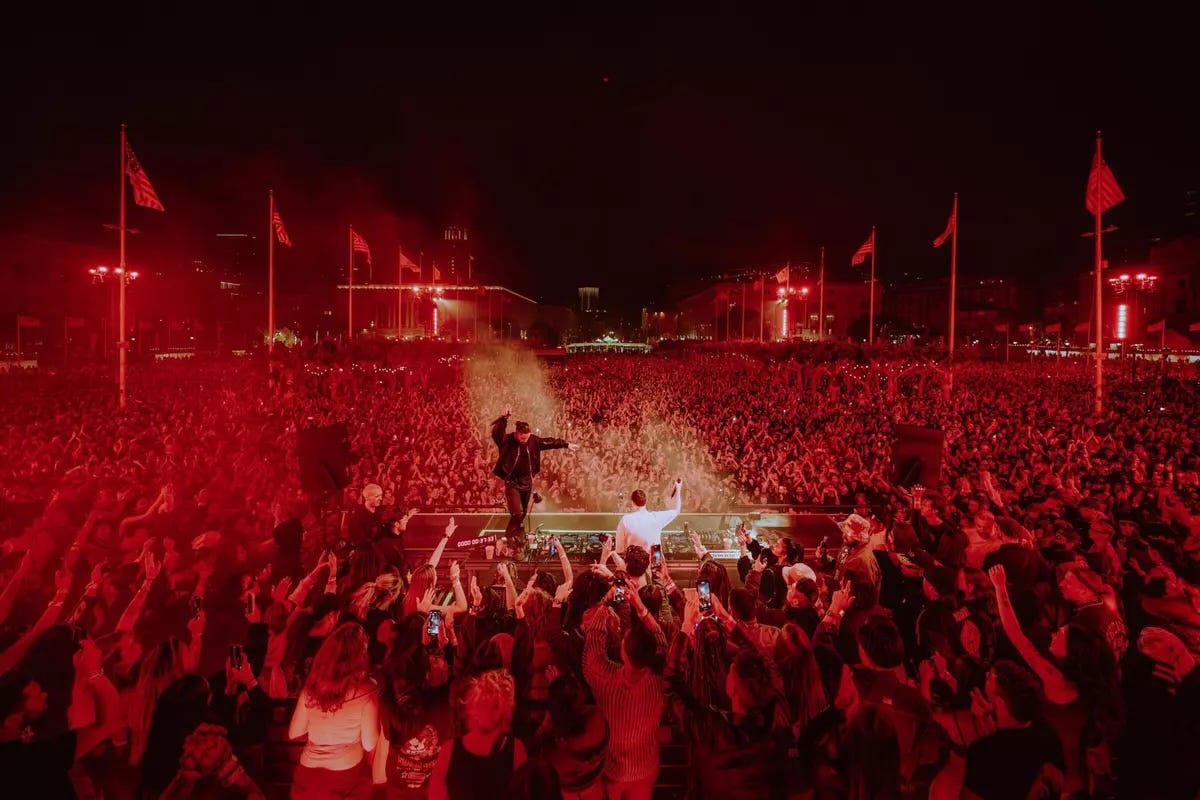
In June 2024, Skrillex – boy wonder no longer, but glowed-up and grown-up in full beard and all-black fit – was joined by British Boiler Room savant Fred Again.. for a ‘rave,’ as the promoters billed it, in front of City Hall in downtown San Francisco. The pair played a three-hour back-to-back set of their own UK garage-inflected tech-house productions with remixes and pop edits sprinkled in. Announced one week in advance, the event sold out within minutes, approximately 25,000 tickets at $100 a pop – the first rave I’ve heard of that cleared $2.5m in ticket sales alone.
Living in San Francisco, sometimes described as a ‘bedroom community for Silicon Valley,’ there is only one thing that truly matters, and that thing is growth. In the 1980s, we said ‘greed is good.’ In the 2020s, we say ‘growth is good.’ This is the logic of Silicon Valley – the logic of venture capital – and it has swallowed us whole.
Several months after the Skrillex-Again rave came the third instalment of Portola Festival, a newcomer to the American festival landscape, held on the decommissioned docks of San Francisco’s industrial eastern waterfront. The two-day festival presented pop-electronic crossover acts (A.G. Cook, Rüfüs Du Sol, Disclosure) beside big-big-room DJs (Sara Landry, Chase & Status, Gesaffelstein), some of whom, with squinting, could make convincing claims to the underground (Joy Orbison, Floating Points, Four Tet). Plus, some curious outliers (Deltron 3030, M.I.A., Natasha Bedingfield). It sold out handily, some 45,000 tickets at $240-$340 and up – a clear winner amidst a dire and depressed festival market at large.
Portola Festival is owned and operated by Goldenvoice, a once-independent LA promoter now subsumed under the umbrella of global entertainment mega-corp AEG. AEG is owned by billionaire Philip Anschutz, a conservative Christian and frequent donor to anti-queer causes, the Republican Party, and all that sort of thing. Some might call that disparity ironic, given that the history of dance music, particularly in America, is inseparable from queer identity and community, and for decades stood as a kind of resistance against homogeneity, a bulwark against assimilation into the status quo. That all seems beside the point, though, when a crowd of 20,000 people enjoying $18 vodka-sodas lose themselves to a DJ wearing a horse mask playing hardstyle remixes of pop songs. There’s nothing ironic about that. That’s as American as apple pie.
And yet the underground never dies, even here in San Francisco, a city so wrenched by inequality that we’re practically synonymous with it. A crew of committed friends and compatriots have put on a handful of renegades on an outlook over the coast, a dozen-plus people lugging whole systems 25 minutes up and down through sand. Recently I joined them, on an autumn night so warm it was foreboding. The DJs kept the tempo up – at one point, two Underworld tracks one after another – until I left just before sunrise amid a dubstep moment, sinuous and space-age, still the best dance music I’ve ever known.
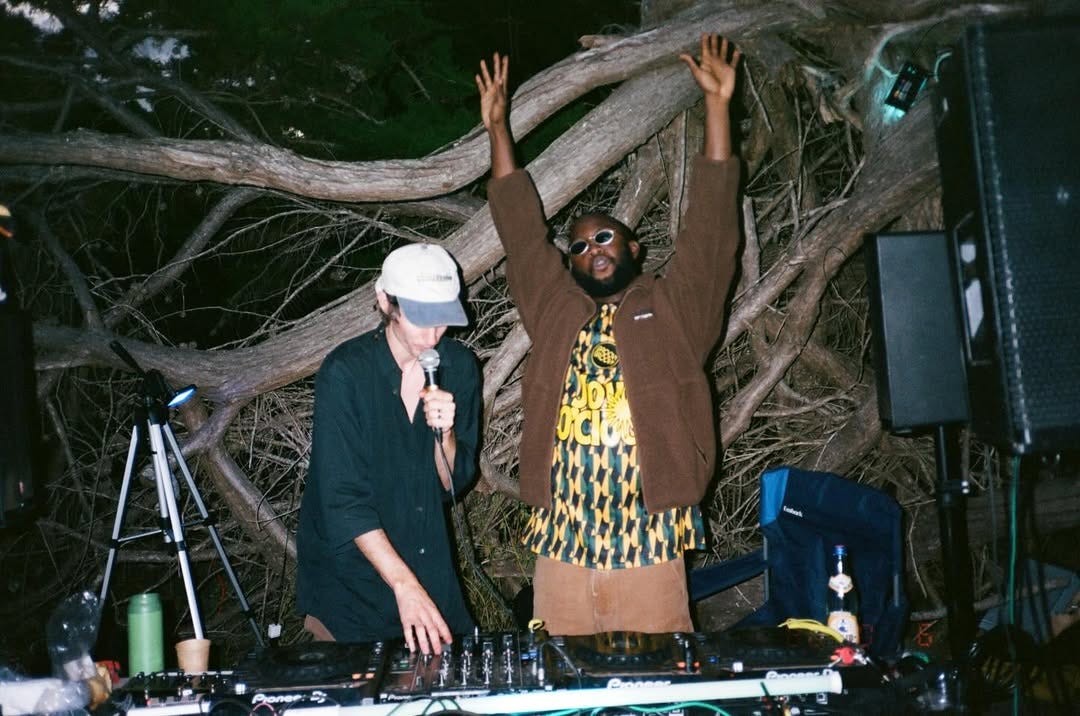
The mood was ecstatic and pure, feral but communal. I remembered, again, why I’ve given so much of myself to this culture and why I feel so protective of it. That spaces like these, outside the bounds of reality and commerce, have integrated me into a community global in scope. That I have forged bonds with people in this community so tightly that they have become family. That to experience one another in the dance is to speak beyond language.
Then it was over, and it was back to normal life in San Francisco, the canary in the coal mine of capitalism, our beautiful crucible of growth: a city where median rent is $3,300, where software engineers and product managers and data scientists are doing just fine, where everyone else hangs on by any means necessary. As the market for club experiences grows ever larger, who will reap the windfall? As ever, to the well-capitalised go the spoils. After all, nothing is more American than making money, and right now in America, the business of electronic music is booming.
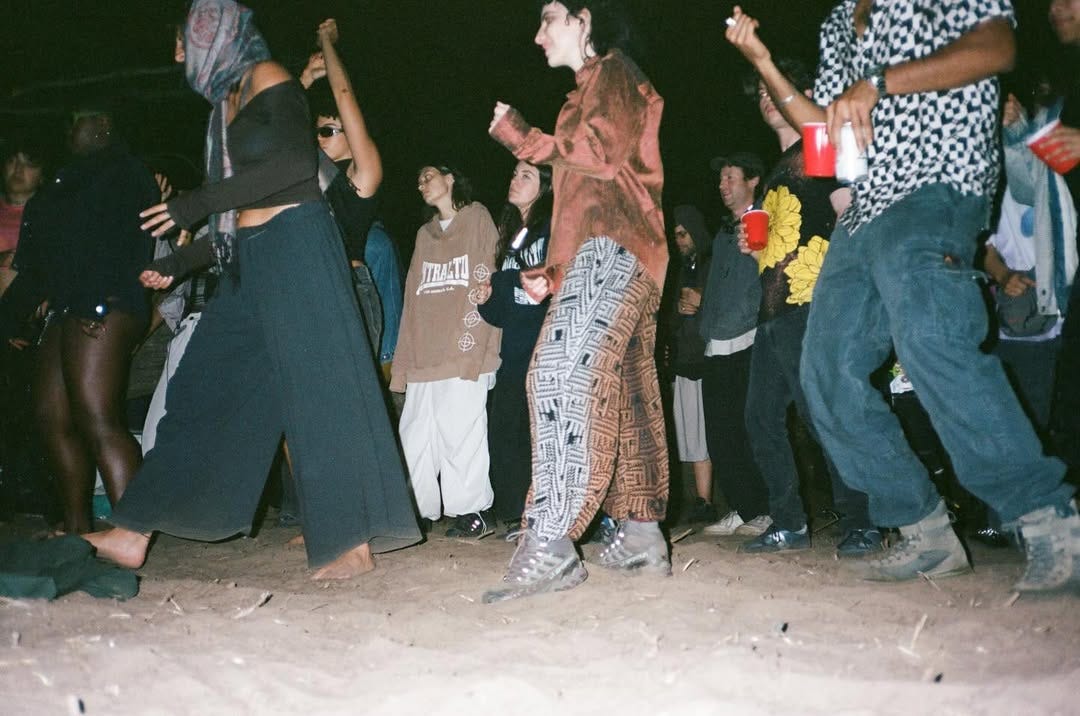
Akanbi’s set at the ‘renegade’ – a free party, SF style.